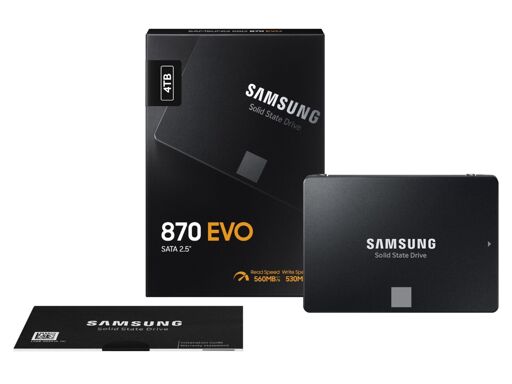
Samsung is reportedly preparing to wind down its SATA SSD business, and a notable hardware leaker warns the move could have broader implications for consumer storage pricing than Micron’s decision to end its Crucial RAM lineup. The report suggests reduced supply and short-term price pressure may follow as the market adjusts.


Y’know what, I honestly haven’t looked at what the PCIe lane layout is like on newer chipsets. Maybe it’s gotten better since I last really paid attention like 5+ years ago. I remember in early-mid AM4 there was a lot of grumbling about how there’s only 20 PCIe 3 lanes followed by early PCIe 4 platforms that would give only 16-20 lanes with another 8 or so PCI 3 lanes. I also didn’t really pay much attention to AMD before AM4 given how far behind Intel they were. But I could be entirely out of date now that I think about it
Phoenix2 APUs like the R3 8300G and R5 8500G are the worst offenders in the ‘cutting PCIe lanes’ department.
The R5 8500G only has 14 lanes, for example. The FX-8350 and 8370 from a decade earlier, would’ve had 32 lanes available on the 990FX chipset, and half that on the 990X and 970 chipsets per contemporary reviews from when those CPUs were new, but they were all PCIe 2 as AM3+ was a PCIe 2 platform.
This is the specific review I’m going off of for this. FX-8350 review
Per that review, 990FX would’ve supported 2 x16 or 4 x8 slots, while 990X would’ve supported 2 x8 slots, and 970 would’ve only supported a single x16 slot, but of course configs varied by the board makers, and there would’ve been nothing stopping someone from making a 990FX board with a single x16 slot, three x4 slots, and two x2 slots, for example, nor a 990X board with a single x16 slot or a 970 board with a single x8 slot and two x4 slots.