

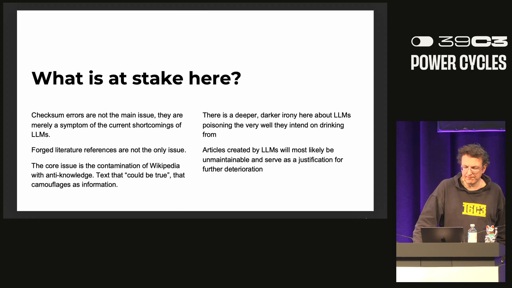
A talk from the hacker conference 39C3 on how AI generated content was identified via a simple ISBN checksum calculator (in English).
A talk from the hacker conference 39C3 on how AI generated content was identified via a simple ISBN checksum calculator (in English).
TL;DW:
He wrote checksum verifier for ISBN and discovered AI generated content on Wikipedia with hallucinated sources. He used Claude to write the checksum verifier and the irony is not lost on him. He tracked down those who submitted the fake articles and determined many are doing so out of a misplaced desire to help, without an understanding of the limitations and pitfalls of using LLM gen content without verification.
What’s the irony?
He used AI to write the anti-AI tool
Heads up he talks about this specifically at 26:30 for those who didn’t take the time to watch the video.
To be fair, humans are excellent at building anti-human tools
Which is kinda my favorite thing to do as of late, and what I prefer AI be used for.
I’m not taking about building a suite of black box tools. But tiny scripts to scrape, shape, and generate reports. Things I used to pull in a dozen node libraries to do and manually configure and patch up.
You know, busy work.
But wasn’t the issue with the AI stuff that it was false info, whereas the tool sounds like it worked as intended?
Here’s the explanation of the irony in this situation from an LLM ;)
Side note: I’d only thought about the LLM generated code irony. I’d missed the 2nd irony of the editors trying to be helpful in providing useful accurate knowledge but achieving the opposite.
It just seems like the tool he is using is working though…
Yes. Why are you fixated on this? LLMs are tools and they work, but you have to understand their abilities and limitations to use them effectively.
The guy who needed the anti-ai tool, did. The Wikipedia editors, didn’t.
I feel like it would be a lot more ironic if the tool didn’t work. It doesn’t seem very ironic to use hammer to remove nails hammered into incorrect position with a hammer imo.
Good for you I guess? Idc
Yes, but the specific type of irony that this situation fits the definition of does not come from whether or not the tool they used worked for the intended purpose. The irony comes from the fact that they are relying on the output from LLM-generated content (ISBN checksum calculator) to determine the reliability of other LLM-generated content (hallucinated ISBN numbers).
Irony is a word that has a somewhat vague meaning and is often interpreted differently. If the tool they used did not work as intended and flagged a bunch of real ISBNs as being AI generated, the situation would (I think) be more ironic. They are still using AI to try and police AI, but with the additional layer of the outcome being the opposite of their intention.
But how does that diminish the irony? The story is still ironic as a whole, even though he achieved his goals.
I would feel like it would be ironic if it was after AI in general instead of the mistakes, I dunno
Right, but it’s also the same/similar tool that’s being used to damage the article with bad information. Like the LLM said, this is using the poison for the cure (also, amusing that we’re using the poison to explain the situation as well).
Yes, he’s using the tool (arguably) how it was designed and is working as intended, but so are the users posting misinformation. The tool is designed to take a prompt and spit out a mathematically appropriate response using words and symbols we interpret as language - be it a spoken or programming language.
Any tool can be used properly and also for malicious/bad via incompetent methods.
But in this case the tool actually works well for one thing and not so well for another. It doesn’t feel that ironic to use a hammer to remove nails someone has hammered to the wrong place, if some sort of analogy is required here. You’d use a hammer because it is good at that job.
See, that’s where you’re wrong though. AI is about as competent at natural English as it is writing code.
I use it for both at times, since it can be an easy way to both rubber duck debug my code as well as summarize large projects/updates in ways that are easily digestible when I don’t have the time to write out a proper summary manually. But in either case, I have to go back and fix a good bit of what’s provided.
AI is not great at either option, and sucks at both in different ways. Saying AI is a hammer is not supwr helpful, because hammers have a defined use. LMMs are a solution looking for a problem. The difference between the posters and the researcher is that the researcher has an advantage that he both knows what he’s doing and knows how to fix the turds he’s provided to make it work, where the users are just trusting the output.
I don’t know how to explain the irony any better in this scenario, but it’s there. If the users actually fact checked their output, we wouldn’t be having this discussion. Same as if the researcher chose not to validate his output. The issue isn’t necessarily the use, but the usage. So this is akin to the posters using a hammer to put up a shelf, but they didn’t look at the directions and saying “yep, that looks right”
I think the point is it would have been truly ironic if the AI itself was the authoritative fact checker instead of merely being a tool that built another tool.
If Claude was the fact checking tool instead of the ISBN validator, that’s the real irony.
If in a messed up future, only an AI could catch a fellow AI, what’s stopping the AI collective from returning false negatives? Who watches the watchers?