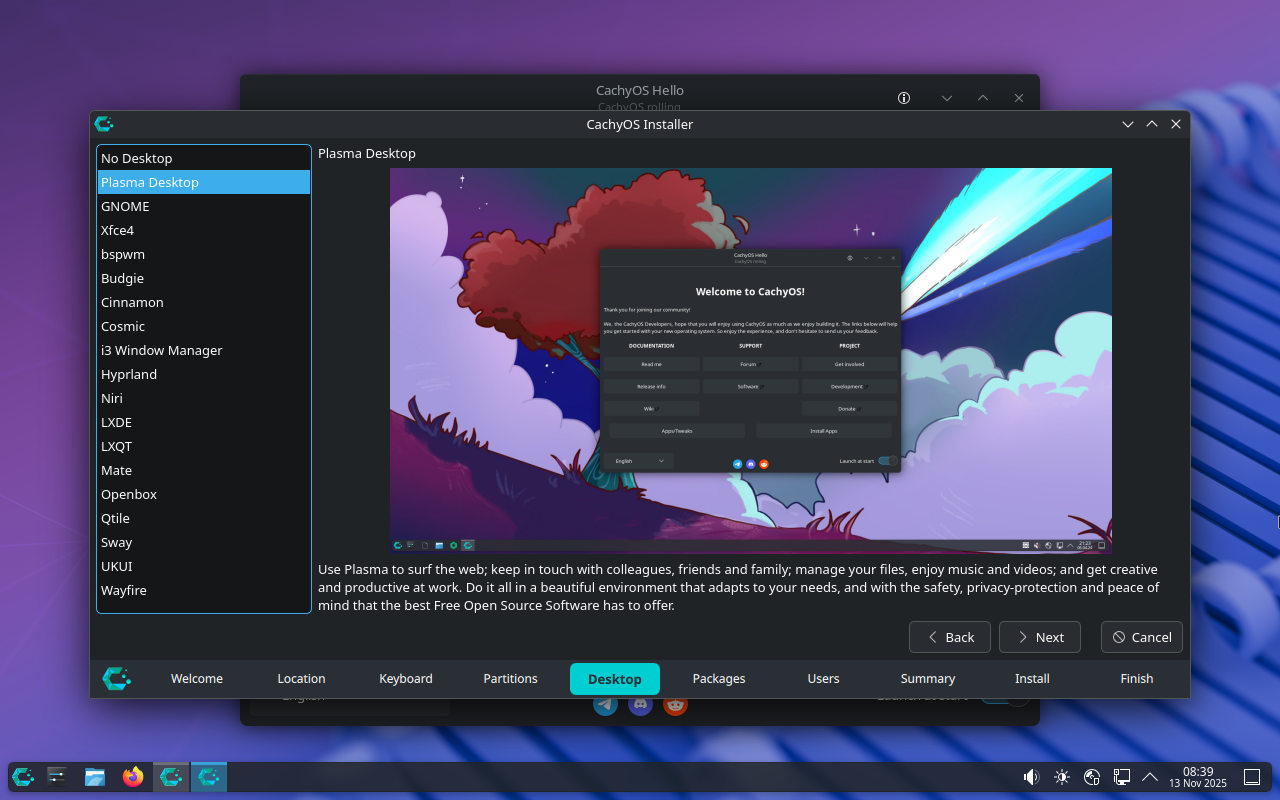

It’s very nice to not have a dozen different versions of the same distro to parse through and figure out that are simply the same distro with a different DE. Moreover, very few of them offer this many options.
Cachy could be doing a better job explaining what the user is looking at here and who each of these is for. Pretty easy to sum up in 1-2 sentences…
Installing additional DEs should be made more straightforward. I’m comfortable using the terminal but I don’t think many know that you can have multiple installed at the same time and can switch between them at login.
Being able to doesnt mean its recommended. I played around with that in a vm and it looks like some DE use same parts of the config files. Which result into inconsistent themeing/UI. Like random wrong colors, icons and fonts.
Pretty easy to sum up in 1-2 sentences…
Then by all means, give them your 1-2 sentences per DE so that they “only” need to include them!
Frankly, I think it’s a lot harder than you’re making it out to be, especially over such a large range of DEs. Not that the suggestion is without merit, just that the assumed difficulty of making it work as intended (i.e. actually helping a new Linux user pick the “right” desktop environment for them) seems underestimated.
Maybe Cinnamon can get away with “it’s like windows 95”, but Gnome and i3 are quite different from anything the target audience has ever experienced.
Gnome: It’s like MacOS
It’s not at all like MacOS.
KDE is closer to finder than Gnome Shell.
this is just calamares, the most used installer across the span of linux distros.
on the question of why this approach vs dedicated desktop environment installs, well, ive always wondered about the pros and cons on that too. one pro is that with a dedicated DE iso you dont need an internet connection to install it. otherwise im not sure why people would choose one or the other.
Simplicity for users and support staff.
I don’t think that the average user cares for customisation far beyond wallpaper, and perhaps theme. Note I’m not saying average Linux user, I mean average person using a device. Think your aunt who can’t plug in the printer. Faced with too many options people shut down.
If you have a distro and need to offer support for it, it also helps if you can write guides and instructions for a single type of scenario. With Windows you can say “right click the start menu, click device manager…” etc, but that’s not quite as easy on Linux. You can always direct people to the terminal, but again, the average user is likely to balk at the idea.
Choosing a dedicated DE means you have less to maintain, and less to support, and can focus your efforts elsewhere.
one pro is that with a dedicated DE iso you dont need an internet connection
That’s a good reason. I didn’t realize this one did.
It’s not 100% true that you need an internet connection…your install media will just be unnecessarily huge since 100% of users will only be using part of it. And, you’ll have to pay to host and distribute it, most for no reason, every time.
It would be cool if they did make an “everything” image for offline installs though; as preparation when when they take away the internet…
you’ll have to pay to host and distribute it, most for no reason, every time.
I DLed Cachy with the torrent. Another thing I wish more distros would offer, haha! It was 2.8GB. I’m not sure if that’s big or not really, I don’t typically pay attention.
I had an Ethernet cable connected so I wouldn’t have had to connect it manually, that’s why I don’t know if it was necessary.
I DLed Cachy with the torrent. Another thing I wish more distros would offer, haha!
I don’t think I’ve ever encountered a distro that doesn’t offer a torrent download option, since it saves the project expensive hosting costs.
i think that’s calamares, so any distro that uses it can technically do this. the reason most don’t is that you can just add more DE’s after install. i know endeavourOS and openSUSE do this, and i think fedora has something like this too?
but the main reason is to keep install size to a minimum. if you want your system to be installable without an internet connection you can’t just ship every DE known to man.
Maintenance burden.
Sorry, what burden?
Maintenance. Your distro has to support all the provided desktops, which includes a multitude of display managers (“login mask”) doing their own opiniated session thing.
For example, Gnome is no longer supported by Artix, because they have now a hard requirement on Systemd.