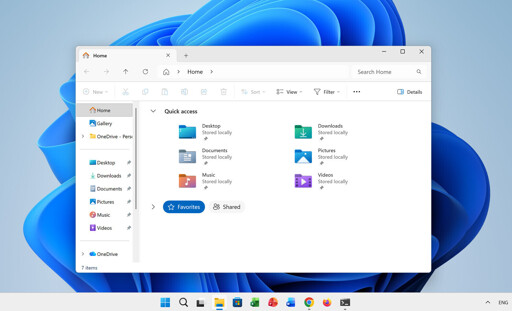
Just a week ago, we discussed Microsoft's efforts to enhance File Explorer performance by preloading the application at startup. Recent testing by Windows Latest suggests that this approach results in diminishing returns, as the application uses more RAM while offering only marginal performance impr...


It’s crazy to me that I’m recommending 32GB RAM systems to everyone now because I regularly get alerts for a good chunk of machines that hit close to 16GB usage.
My Linux desktop boots so fast and I can’t tell ya how much ram on boot but I’m pretty sure it’s still less than 2GB 😂
Windows is like 6 or 7 easy.
32 is bare bones for Windows nowadays! You actually need it. I’m at 10 GB just running nothing with Windows, not even starting a game. Omg and I thought fast boot, was faster until I went to Linux. I also feel like Windows somehow made my motherboard boot slower as well.
Windows has enough money to make it’s DE experience better but they don’t care out it’s end user.
They only care about siphoning our data and advertising to us. And vibe coding apparently. Such a buggy pos these days.
Well I dual boot & the preview update they sent for explorer crashes every time it tries to install during a restart & it says something went wrong, then takes another 10 mins to clear that. Honestly don’t login to Win 11 unless I’m playing a multiplayer anticheat game at this point. And I used to bleed green/blue. I had the Windows phone, Xbox all of then, a gaming PC & laptop. I’m degoogling my phone & using Linux for everything else. I still have the switch as well. They got me there with Zelda
On Linux I’ve found it tends to be
1-2GB console onle, or very basic GUI 4GB desktop manager GUI 8GB+ GUI and modern tabbed web browsers (they’re memory hogs). Some games 16GB+ Many games from Steam etc
High memory usage isn’t a problem by itself. Empty RAM is not being used. How the system performs when something needs RAM is more important.
My system has 96GB of ram, 24 of which is dedicated to a Windows VM. Right now, I have only 3.5Gb free because of everything I’m running.
The important thing is, if I run a new task that requires more RAM, my system will cleanly reallocate the RAM to where it’s needed with no latency or performance hits, or stuttering.
In the meantime, it’s not sitting there, unused and useless.
When I had Windows on this same system, with less RAM, it performed worse when it needed to swap in RAM.
The issue is when it’s used inefficiently or for useless purposes. An unoptimized application takes 500MB of extra memory and that is 500MB that cannot be used for read/write caching nor another application, and 500MB closer to an OOM situation.
In theory, an application can suffer from issues of underutilization of memory, just as one that over-utilizes memory. In practice, I find that lower-than-expected memory use is a much more positive indicator of an optimization-focused project than one that uses more memory than expected.
If your system uses caching, then “usused” memory may not be so. Memory used for caching is also cleanly “Available” for use if needed. This is not the case with the 500MB of extra memory a process might decide to capture. Of course this is complicated further with swap (I wouldn’t use it).
This is my point.
Well it is a problem when it’s consistently getting close then I get tickets that computers are performing poorly shortly after. You’re on the cusp of page thrashing if you’re high on usage.
Your use case is not a typical one either, compared to what I’m dealing with. It sounds like maybe you have a few heavy hitters, but when you’re constantly switching between MS office, web pages, and CAD and things like that it becomes very noticeable. If a machine has 15.6GB used out of 16GB, a single web page could trigger some thrashing.
For example, I regularly saw Palo Alto panorama use around 1GB for just the single web page 😅
Right, but that’s not a high memory problem, that’s a Windows is shit at managing memory problem.
If MS fixed that, you could easily run memory hot at >90% without issue.
It’s also a software developers are making poor products problem. Even back when I was on Windows, I swapped out MS Office for Libre Office and then OnlyOffice. In both cases, my system performed better just by not running MS Office. That’s not a memory usage problem.
On my work laptop. which runs Windows, I removed the entire Adobe suite, which I don’t use for anything, and my overall system responsiveness increased. Again, not a memory issue, an poor programming issue.
Devs (the companies, not the individual programmers) know that users will throw more RAM at a problem, so it absolves them of the need to write better code. If Windows had a better memory manager, and Office and Adobe were more efficient, you wouldn’t need more RAM.
Also, just to clarify a point. Right now, web browsers, the worst abuser of memory, are taking up 24GB of ram on my system.
Because I have no memory swapping issues, I keep many open web browsers, which most people can’t if they are on Windows because it’s crap at memory management.
So our list grows to, crappy memory management on Windows, crappy development of web browsers, crappy development of applications, and crappy web pages (as you say).
None of that is a low memory problem, it’s all poor software development. When RAM was super expensive, developers (again companies, not individuals) got lazy and stopped caring about efficiency.
We don’t need more RAM, we need better code. There is no reason anyone running normal usage should need that much RAM.
To make my point, I just SSHed into my wife’s Linux PC, which she never closes anything, and this is her memory usage with a bunch of browsers doing all the normal things she does, and multiple spreadsheets open in OnlyOffice.
Memory: Total: 16278284 Used: 6254884 Available: 10023400
Edit: BTW, I do understand your point. You can’t fix any of that. My point is we need to put blame where blame is due. And it’s not that memory is low.
It’s not a windows is shit at managing memory problem though. If you have 1MB of RAM left and you open something, something has to happen. A process killed, an alert generated, something moved to disk instead of RAM (paging), or a system lockup or something. This is the management piece. What to do when you’re out.
That is entirely a shit at managing memory problem.
If you have 1 MB of RAM left, firstly, your OS has not properly managed it’s resources. It should have reserved system RAM. Secondly, a good memory manager will have swapped out unused, or low priority pages.
And that’s not just a system issue. A well developed piece of software will unload (or never load) parts of the software that are not needed at runtime.
I’m going to give you a great example I just read about today, about bad programming practices. The install of Helldivers 2 has been reduced from 154GB to 23 GB. That’s a reduction of 85%. This was driven by de-duplication of code. So, while this is a storay about storage space, ask how many modules and functions were duplicated, and how many of those were loaded independently into RAM.
Bad programming in one area, means bad programming in all areas.
With your 1 MB example, I would ask if all of the devs who created all of the other programs on the system had written better and more efficient code, would you still need more RAM? The answer is no.
My Debian server without an DE takes about 900MB on boot
The IoT edition of Windows 11 runs in 4GB ram and performs ok. I don’t recommend more ram, I recommend either Linux or LTSC IoT.
Ya that would not be a sustainable option in my case unfortunately.