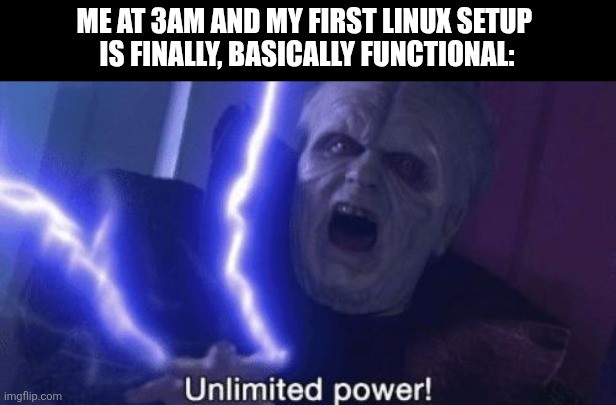
Now, to figure out all the stuff I could never really get windows to do…
You must log in or register to comment.
This but reversed. My first install was up at 3pm, got it to not login anymore at 3am. Prelude to an
horribleamazing relationshipSpent a couple hours over the last few days trying to get Bambu Studio to work on Ubuntu 24 and haven’t figured it out yet. A couple hours does not include the additional hours required to build it.
Another reason I’m glad I ordered a Prusa; I’ve already been using PrusaSlicer for my old printer, so I know the toolchain is ready to go.
I had a Prusa for several years before switching to Bambu. Can’t go wrong with either brand imo. Although I have blocked my Bambus and their slicer from communicating with the outside world.
Sounds like you can go wrong with one of those brands.
Meh, the hassle of blocking the Bambu stuff is worth the print quality, reliability, and multicolor printing capabilities. I tried the Prusa MMU2S and ended up giving up. I had less than a 5% success rate with multicolor prints.
Edit: my phone keeps auto correcting Bambu to Bambi
I put together an original MMU for a customer back when it came out, I don’t think it ever worked. I might try an MMU3, they’ve apparently got it reliable, but I’ve been 3D printing since 2014 and haven’t really found much of a need for multicolor printing that I couldn’t do by snipping the filament and pushing different filament into the pinch rollers to make, like 2.5D signs or something.
I thought I’d step out of my Debian/Arch comfort zone by installing OpenSUSE on an Intel MacBook - Tumbleweed has trouble working with the Broadcom wireless adapter, and Leap straight up kernel panics because it can’t find root on boot.
It’s been actually educational and almost nostalgic in that it makes me feel like a total Linux noob again as I try to navigate zypper and YaST.
Once I get it working this meme will feel extremely relatable.
Oh, i’ll just fix this last little thing.
… 06:00
pm? 😁
Everyone not familiar with Linux should note that this is probably partially a joke and a very uncommon thing.
These days your basic Linux installation requires very little time and knowledge.
I recently installed Mint for my first Linux and honestly it took me a few days to get it set up fully. The initial install was really quick and super easy, 90% complete in an hour. But, for example, my speakers didn’t produce sound. Four hours of trying to force drivers and all sorts of bizarre fixes, finally post on the forum for help and find out there’s a hidden volume setting in alsamixer that was set to 0.
Still better than windows.
Yeah, Linux really suffers from the 90-10 principle. You’ll spend 10% of your time getting it 90% functional… And that remaining 90% of your time will go towards the final 10% of functions.
Thats how I landed on Fedora, it just worked the most consistently
This is probably an old meme but still completely true with Gentoo. :)
I know running Gentoo is labour intensive and for the most part unnecessary. Something still draws me back and every now and then there’s a fresh install.
Exactly. I’ve been up for 27 hours, but I finally have a booting Gentoo install now. 😃
Gentoo installs are not that bad these days. However, back in 2005, it would take, like, a day or so to compile the kernel on my old Pentium M Thinkpad. I would run through the install, start compiling the kernel, and go to sleep/work/whatever. I would check on it periodically to see if anything went wrong, and eventually it would get to the point where I could reboot and find out I messed something up and had to start over. That was like a week, and then I installed Ubuntu. 😂
Oh the useless hours spent compiling Firefox…
I still remember compiling LibreOffice for 2 days. :)
It’s usually something unrelated to the OS that I am staying up all night trying to get working. One time I realized it was because I was trying to use an x86 program on ARM for a Raspberry Pi and I felt like an idiot spending so much time troubleshooting to find that out.
Installing the OS is simple. I’d go as far as saying it’s now easier & faster on most distros than installing Windows, considering you’re not hunting down the latest exploit to bypass signing into a Microsoft account or having to go through all the prompts you’re going to say no to anyway and not having to remove all the bloat and reverse the stupid Microsoft defaults and startup crap like McAfee…
I reinstall mine around 2 times a year, partly habit, partly some time I accidentally fuck up. Not counting the time to download the installation media, and though I become faster at setting things as I like each time, best I do is still some 2 hours. For someone not used to the environment or even just starting, I’d easily expect it to be much longer.
Absolutely agree! It was amazing how much just worked.
I spent a lot of time tinkering and just having fun with all my settings etc. Though I did have to battle a little as my setup, which gave Windows headaches, is a little unusual. (Three screens, one is connected to a receiver and then to a tv, so the sound and third screen are connected. I’ve got it functional etc but am really looking forward to diving in and getting everything to work well!)
Yeah I got my first distro working in like an hour (including installation time) with literally zero prior experience.
Which distro?
Asking for everyone.My first was Slackware. I don’t remember much other than following instructions really well and coming away with a working, albeit slow, OS. There was a joke video making the rounds back then of someone opening their laptop in a library or something and the Windows startup chime playing so slooooooooow. That was unfortunately my embarrassing experience, in a community college class, with the KDE startup chime. I didn’t know anything about TWMs, the terminal, or anything else really and foolishly thought my secondhand, 90s Compaq Presario (?) laptop would run a full DE in the mid 00s.
Anyway I got Ubuntu running a while later, when the Beryl (Compiz) cube desktop videos were showing up everywhere, and it was much easier. Same time Live CDs got popular and you could test run the OS. Then did Debían for a while because I hated Unity and the end of Gnome 2. Riced out Arch with Xmonad after that, learning Emacs, Vim, TeX, Bash and so on along with the various coreutils. Arch(wiki) and some solid YouTubers got me finally learning to be a proper power user.
Now, servers aside, I’ve just got a Steam Deck and WSL. My next build, when/if prices get less stupid, will probably be Arch again unless I do the lazy thing and run with Bazzite or similar. I love Arch but I hate the occasional troubleshooting after I don’t update for a while, even if I have gotten better at it.
Damn. I read Compaq Presario and suddenly tasted bile. I’d almost forgotten about them.
Just the battery for the thing probably weighed more than my next two laptops combined, and one was a 17" “Media” edition HP with the DVD ROM and the full keyboard with numpad. I actually loved that machine, and it ran Arch for a good while, before HP’s garbage thermal management (and, likely, aging solder) killed it.
I still have it because of sentimental stupidity and it being the only one I’ve ever stickerbombed the hell out of. I might need to craigslist a toaster oven just for hobby projects and see if I can bake it back to life. Would make a fine addition to “in case of LAN party” stack of old laptops I keep around for when friends are over and want to run some CS:S, Quake 3, Brood War or whatever.
I am glad you have fond memories of it. I had to support them in a business environment so my perspective is somewhat different, lol.
I should’ve clarified: “I actually loved that machine, referring to the HP*, …”
The HP was my first successful Arch machine, after various failures due mostly to impatience and incomplete knowledge; failing to install necessary drivers, not understanding how easy it is to just boot the live media, chroot back in and fix those sorts of things, and so on. It marked a point in my life where I just really went into crunch-mode, consuming as much as I could about as much as I could.
The Compaq was a hunk of junk, even when it was new. I can’t imagine servicing them was remotely pleasant, but I’ll give it credit for being the first machine I ever ran Linux on. Even if it did so poorly, “we all start somewhere.”
Went with Mint as I was pretty nervous. Already thinking about which distro for my old laptops though…
Mint is a solid choice.
Ps. My (unsolicited) advice is this: at any time, make sure you have at least one computer that works.Thanks! I’m lucky and at home I have a pair of computers from work. And happily, had so few issues with the initially install that I didn’t really need to use them!
(That being said, absolutely great advice.)
I run Pop!_OS, btw
Arch btw, fedora worked too well and was boring, gentoo was too entertaining, arch is the perfect balance of works and allows tinkering for me.
I am currently afflicted w fedora boredom but i have to deal with it until my current project is over
I’ve got an immutable Fedora distro so I haven’t needed to do anything for 2 years so far.
Got into self hosting to scratch that itch. Every virtual machine gets a new distro woo!!!
Try spinning up gentoo on a usb drive when u have some free time, if u can get a sucessfull install its the best feeling.