Like, English is a famously difficult language, and Spanish is supposed to be easier. But babies learn English or any language instinctually.
So do babies learn faster if the native language is easier, or do they acquire language at a constant rate depending on their brain development or whatever?
Since the main question here has already been answered by the Danish/Norwegian post, I would like to address something different. My native language is Spanish, and I completely disagree with you.
English is a lot easier to learn to speak than Spanish. Spanish has everything English has, plus:
- Conjugations (corro, corres, corre, corremos, corréis, corren, corrés, corría, corrías, corríamos, corríais, corrían, corrí, corriste, corrió, corrimos, etc, etc, etc vs run, runs, ran, running)
- Gendered words (La Tienda, Las Tiendas, El Pape, Los Papeles l vs The shop, The shops, The Paper, The Papers)
- Purposefully misgendered words in certain contexts (i.e. Feminine words that use the masculine article in some occasions: El alarma, Los alarmas)
- Particles that change because of sound (Ostras o mejillones/mejillones u ostras : oysters or / mussels/mussels or ousters; insectos y arañas/arañas e insectos : insects and spiders/spiders and insects)
- Extra sounds (hard R as in “Raton”)
- Temporary being verb (Ella es rubia/ella está rubia VS she is blonde/she is currently blonde)
The complications in English are later, after you know how to speak and have to learn how to write it, but we’re talking babies learning here. Spanish writing is much easier than English because it’s very phonetic, but just the conjugations are enough to drive English speakers insane trying to learn them because in English you use constructions to achieve the same effect, e.g. I run: yo corro; I ran: yo corrí; I would run: yo correría; I will run: yo correré; I used to run: yo corría; so that I would run; para que yo corra; so that I could run: para que yo corriera; run!: corre!; don’t run!: no corras!. Different verbs would use the same construction in English but may be different sounds for different verbs in Spanish: e.g. I ran, I walked, I had vs Yo corrí, yo caminé yo tuve (and yes, I get that using run is a bad example here since it’s irregular, but it’s only one of a handful, whereas Spanish has different conjugations for different verbs plus some irregular ones)
IIRC (and heavily paraphrasing here as this isn’t my specialty to say the least) most languages end up having about the same information density because most humans process language at the same speed. Some languages are spoken faster, but have less density in information, where others are slower but have higher information density. In The end it evens out, more or less
From that, without looking at other facts, I’d guess that babies learn it pretty much at the same speed, no?
you into linguistics?
Yes, to an extent, but I don’t think it has to do with grammar as much as pronunciation. Norwegian (bokmål) and danish are almost indistinguishable when written down, but spoken Danish is pronounced very weirdly (a lot of swallowed and mumbled consonants that causes it to sound like the speaker has gotten drunk on their way back from getting a root canal and is currently struggling to eat a hot potato). Despite Norwegian having a massive range of regional dialects, Norwegian kids learn to speak a lot quicker than danish kids. Largely because danish kids just don’t understand what they’re hearing for longer. The Danes have to subtitle their own TV programmes because they don’t really understand each other. It’s a fucking mess. Norwegian kids understand Swedish before danish kids understand danish.
It sounds like what you said is a joke, but just wanted to underline that this has even been subject to scientific study, e.g. mentioned here: https://theconversation.com/danish-children-struggle-to-learn-their-vowel-filled-language-and-this-changes-how-adult-danes-interact-161143
This answers exactly what I was asking, thanks!
Also I remember reading a newspaper account of a danish supermarket that actually ordered 1000 litres of milk by mistake. And everyone in Norway found it hilarious, because it happened after the sketch was aired.
No one mention the Norwegian butter crisis!
That was rough. It happened right before Christmas too. People were scalping butter on finn.no and supermarkets had to import butter from France.
a lot of swallowed and mumbled consonants
This has been my experience learning French. The written language and the spoken one are pretty wildly out of tune, with up to ~5 letters at the ends of some words either not pronounced at all, or heavily swallowed.
Learning the pronunciation of Castellano (i.e. a sister language) was vastly easier for me.
Like learning Norwegian (bokmål) while living on the west coast. French vocal r, secondary Norwegian language, one hour travel north or south can be regarded as a completely new language. Nice fjords, though.
Like learning Norwegian (bokmål) while living on the west coast.
In all honesty, I’d be absolutely terrified of trying to learn a Nordic language, which is absolutely NOT due to the lovely Nordic people I’ve met across the years.
It’s a “me” problem, and case-closed, please.
Yes we make fun and talk about how bad it is, but in reality this got me curious, what is it with Nordic languages that is so off putting to you?
Well… I mean… what later become “English” branched off from its West-Germanic roots, long ago, and never did become “High German.” So theoretically, as an English-speaker, I have great familiarity with modern French, and we share the same basic sentence-structure as with modern German. Some of that is actually true. In practice, I could not be more of a complete dumbass upon those languages.
TBC, I can speak Castellano and Français like someone with heat-stroke, and I can vaguely understand Dutch and German.
Ataturk famously switched Turkey to a modified Latin alphabet instead of an Arabic-based one in order to boost literacy rates. Combined with a huge push to educate people on the alphabet it seemed to be successful.
Based. Many are saying polish would make more sense in a Cyrillic alphabet. I couldn’t say
I’m of the view that a bunch of digraphs would be reduced to single letters if Polish used the Cyrillic script. But some commenters noted that other letters don’t map that nicely. However, then again, variations of Cyrillic across Eastern Europe and Central Asia include a range of letters that aren’t in Russian, for example, so idk why Polish couldn’t use those or add a few of its own.
Yeah. As far as I can tell, no two languages share an identical Cyrillic alphabet.
Also Bulgarian, but I know some Bulgarians that just write with Latin letters because it’s quicker, given that they live in a Latin alphabet country.
It is not quicker to type Bulgarian in Latin quite the opposite. There are sounds in Bulgarian that using the Cyrillic alphabet are represented using one letter, where as with the Latin alphabet you need 2 or in one case 3 щ = sht.
Usually people that write with Latin are just lazy to switch keyboards.
Yes, I’m sorry. I meant it’s quicker because they don’t have to switch keyboard layout, not because they save keystrokes
I remember reading somewhere that Danish children on average learn to speak slower than others.
Kamelåså!
Sygelkugle!
Gutesgeet 👋
Skatusen?
Tusen tanks!
I saw a video the other day that repeated that claim, but I can’t remember which video it was, nor can I find a specific scientific paper on it (caveat: there may be a search skill issue on my part).
Interestingly, I did find a paper (https://pubmed.ncbi.nlm.nih.gov/28430531/) that apparently seeks to investigate the claim, but doesn’t mention, in their abstract anyway, any specific papers making the claim. That’s something I’d expect they’d do if they found such a paper themselves, but I can also think of a few reasons that such information might be omitted from it.
English is an easy language, easier than Spanish IMO. If the child lives in a context where the language is spoken all the time doesn’t matter when you talk about a first language.
Why would Spanish be easier than English?
I would judge it to be slightly harder because of gendered words.Spanish is phonetic, what you see is what you get. There’s a few rules around the pronunciation of the letter c and (q)u/h not being pronounced, but it’s otherwise pretty standard. Gender in Spanish isn’t that difficult.
English is a complete mess of a bastard language with more exceptions than rules.
This doesn’t have anything to do with language acquisition by babies, though. Spelling is a completely different subject than natural, spoken, language, and obviously not something babies will come into contact with.
l am German and have learned French as my second foreign language.
French’s two genders are slightly nightmarish and German’s three genders are no better.
Similar for the slavish languages with genders I had a peak into. I expected this to also be similar for Spanish, at least compared to English that I perceived to be quite easy to learn.
Interesting to hear otherwise.
So I now wish that Spanish had been an option at my schools. :-)Je connais aussi le français :) C’est un peu plus difficile que l’espagnol à cause des lettres qu’on ne prononce jamais, mais pas beaucoup en fait
- Spanish and English are my native tongues, French is extra
Spanish is easier in the sense it’s more regular. Genders don’t had that much complexity if they are applied consistently, especially when you stack them against all the irregularities in English. That being said, and without claiming to be an expert, I think the consensus is that language acquisition time is similar across languages, but the time to master the language is related to how predictable/regular it’s grammar and vocabulary formation is.
English is incredibly easy to learn. Why do you think it’s basically the world’s lingua franca? The spelling is just a matter of learning to spell and the grammar is dead easy. I was virtually fluent by the time I hit 11 because I’d been watching English language TV with subtitles.
Why do you think it’s basically the world’s lingua franca?
Afaik until WW2 German still was the lingua franca for academia. What, it became harder after the war? Oh wait, perhaps it’s just fallen out of favor while the US, having not been bombed to rubble and having had an influx of educated immigrants, enjoyed a huge economic boom and resulting political and cultural dominance.
The spelling is just a matter of learning to spell
The drawing is just a matter of learning to draw. What?
and the grammar is dead easy.
Subjective.
But I think it’s “easy” to learn because it’s prevalent. If Spanish or Thai were as prevalent as English you’d probably speak that and think it’s just as easy.
You can learn any language basically through enough exposure to it.
English is easy to get started but insanely hard to master. There are tons of irregular verbs, orthography is all over the place, plurals have more than a few pitfalls, etc.
It is the most schizophrenic language. Super easy to be understood even getting most of a sentence wrong, but can change meaning entirely with just a comma. Has at least two different root languages and as many as five depending on how you define root. Has words from almost every spoken language on the planet and has so many spelling exceptions you can have high level competitions just trying to spell different words.
And all that is just the tip of the iceberg.
Because the British empire was absolutely huge. Which lead to many countries having English as an official language. Which means those countries would conduct trade in English. Followed by American dominance, which also has English as its main language.
And that American dominance includes dominance in media, especially films because of hollywood. Technical documents, research and especially computer-related technical documents are mainly in English for the same reason.
Sure, English is not that hard of a language. But it’s not the easiest either.
Unfortunately, English is not an easy language to learn for people who never grew up with it. I speak from experience, many of my friends do not speak English as a first language and some of the “quirks” of English are really really stupid and make it unnecessarily difficult to learn…
No language is easy to learn for people who never grew up with it (as in, it always takes effort), and every language has quirks. You’re arguing for it being hard to learn a language - this is true - not for English being uniquely hard.
But relatively speaking, whether a language is easy or hard to learn largely depends on the languages you know already, especially as your mother tongue. Dutch is very close to English, and English has borrowed a lot of French vocabulary, so if you know those languages you will not have too hard of a time learning English. To someone who only knows Mandarin, English (and French, and Dutch) will obviously be completely foreign, in everything: grammar, vocabulary and syntax.
I’m Italian and I feel that both Italian and Spanish are way more difficult to learn than English.
English doesn’t have genders, it has way less verb tenses, and you don’t need to conjugate every verb person in a different way for each tense!
has way less verb tenses
Wouldst I have been having an origin and thus a learning experience that might have been comparable to yours, I expect I should will agree with you. But having not had had my way into English from the same vantage point, I am going to have to go ahead and will have disagreed with you, in that in my view tenses in English are son of a fucking bitch.
Look at Italian and you’ll be thankful that English verbs are so easy.
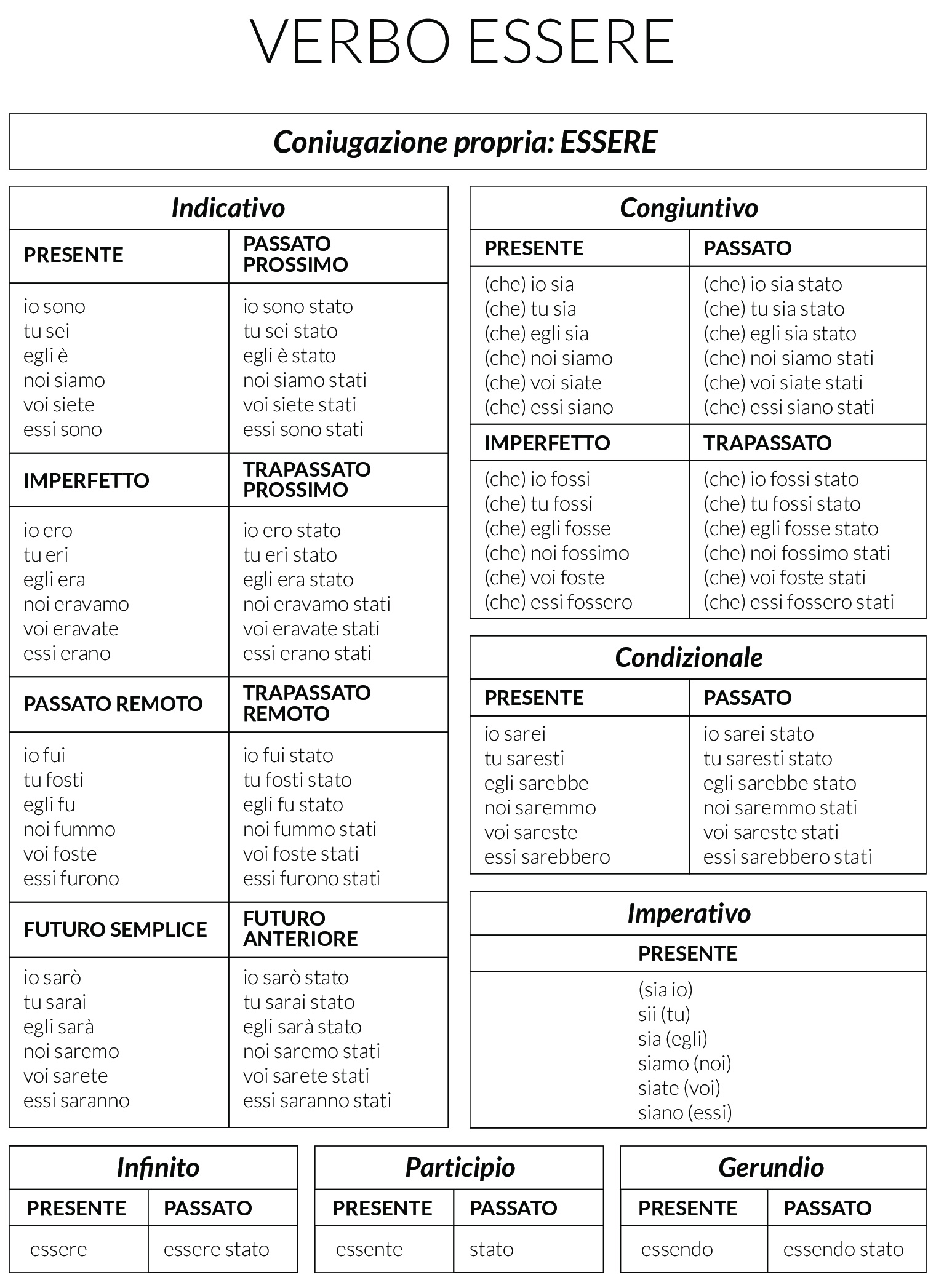
This is the conjugation of “to be” in Italian. You need to learn all those tenses also for “to have” and for 3 different categories of verbs called “-are”, “-ere”, “-ire” (almost 4, in reality, because many “-ere” verbs are irregular).
The number of conjugations is impressive, mostly because of the genders and the plural forms. But regarding the tenses themselves, half of them are formed by adding ‘stato’ to the other kind. Meanwhile English has twelve basic tenses without getting into the subjunctive, conditional and imperative moods (congiuntivo, condizionale and imperativo). The full tense–aspect–mood system greatly complicates things.
l am German and I had the same impression. English was silly easy to learn (I may still have a slightly harsh pronunciatian, though).
No gender-dependent conjugations and the grammatical exceptions are sparse (mainly a few special cases around the tenses).
But learning French, another dual-gendered latin language: total nightmare.
So my surprise that Spanish is supposed to be easier to learn than the already quite easy English language…Another problem with French (that Italian and Spanish pretty much don’t have) is the pronunciation. They don’t have a 1-to-1 relation between letters and sounds.
But that’s also a problem with English.
yeah right? never met an english speaker that got past the most basic levels of spanish
I have!
Bud I don’t think it’s because Spanish is harder or whatever it’s because English speakers generally are pretty content not to learn another language…
I’m no specialist, but I’d say it is all about exposure.
How often and meaningfully they interact with people speaking different languages makes it easier for them to absorb that information. Is grandma the only person that speaks spanish with them when they visit once a year, while everyone else only speak in english? Yeah, it is going to be harder for them to learn spanish
My question is if you took the average for all babies learning only one language, would you see them acquiring that language and speaking at different times based on the difficulty of the language, or around the same time, based on natural development?
Not research, personal experience:
Even after many years of school/high-school in basque, I learnt it at a way slower rate than English, which was just 1 subject.
I didn’t speak neither basque nor English outside school. At most, the difference might be that I consumed a little bit of media in English while none in basque. But all subjects except spanish and English were in basque, so that should make up for the difference.
And I don’t think it’s just a me thing. Since the curriculum has mostly been the same for all those years of school:
Learn how to say a verb.
That’s it. Many years of school just to say verbs correctly.
The exams where mostly just fill in the blank exercises, where the blank was a verb.
I still don’t know how to say verbs that aren’t the simplest ones.
So to your question I’d say yes. Even though neither are my native tongue, I learnt both since I entered school, but learned them at wildly different rates.
you’ve said it yourself, you didn’t use basque outside of school
the education system acknowledges this and makes you repeat the curriculum year after year, so you can get your B2 certificate upon finishing high school
It didn’t make me repeat the curriculum. The curriculum is the same for everyone.
I didn’t use basque outside school, but I barely used English. Inside school, it was ~7 hours every day of basque. And ~3h per week of english.
No, I suspect hearing issues have the biggest impact on how fast they “learn” the language and then social factors, such as increased exposure to people talking , parental attention etc.